
Tokyo in early autumn does not change overnight. September afternoons can still feel like summer, cicadas continue to call from the trees, and the leaves remain mostly green. Yet if you slow down, smaller signs begin to appear: cooler evenings, the sound of autumn insects, silver pampas grass moving in the breeze, and tiny seasonal flowers opening beneath the trees.
One of the best places to experience this quiet transition is Tonogayato Garden (殿ヶ谷戸庭園) in Kokubunji, western Tokyo.
Only a short walk from Kokubunji Station, this peaceful garden feels surprisingly far removed from the busy city. Rather than impressing visitors with enormous buildings or dramatic scenery, Tonogayato reveals itself gradually. A bright lawn gives way to a shaded slope, bamboo grows beside narrow paths, and at the bottom of the garden, natural spring water feeds a tranquil pond.
For travelers visiting Tokyo in September or October, it is a wonderful place to discover a season that exists somewhere between summer and autumn.
A Garden Shaped by the Land
One of the most distinctive features of Tonogayato Garden is that its landscape was not created entirely from scratch.
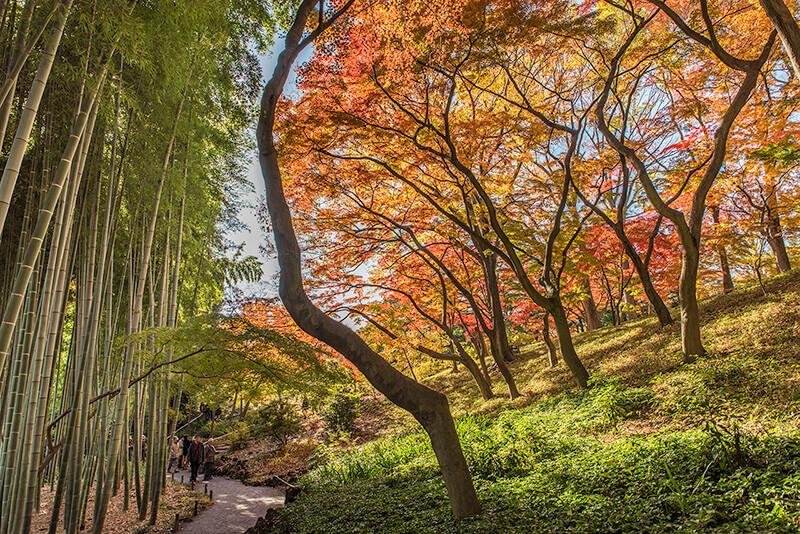
The garden makes clever use of the natural terrain of the Musashino Plateau, particularly the steep difference in elevation created by a terrace cliff. The upper part of the garden is open and bright, with a spacious lawn and seasonal plants. Follow the paths downhill, however, and the atmosphere changes completely.
Trees become denser, the air feels cooler, and eventually you arrive at a pond surrounded by deep greenery.
This contrast between light and shade is central to the garden’s design. Instead of flattening the land, the creators allowed the existing landscape to shape the experience.
The garden was originally developed as a private villa between 1913 and 1915. It later became a residence of the Iwasaki family, associated with the Mitsubishi business group. When development threatened the area decades later, a local movement to protect the garden helped lead to its preservation by the Tokyo Metropolitan Government.
Today, it survives as an intimate reminder of what the natural landscape of western Tokyo once looked like.
Following the Water to Jiro Benten Pond
As you descend through the garden, one of its most beautiful features slowly comes into view: Jiro Benten Pond.
The pond is fed by natural spring water emerging from the Kokubunji cliff line. Surrounded by trees, ferns, moss, and bamboo, it has a completely different atmosphere from the sunny lawn above.
Nearby stands Koyo-tei, a traditional-style building overlooking the water. From here, visitors can pause and enjoy one of the garden’s most peaceful views.
This is not a landscape that demands attention. There are no enormous waterfalls or monumental structures. Instead, the pleasure comes from smaller details—the reflection of leaves on the pond, the sound of water, sunlight passing through bamboo, or the sudden movement of a dragonfly above the surface.
It is exactly this understated atmosphere that makes Tonogayato so appealing.
Tokyo has many magnificent Japanese gardens, but this one feels unusually personal. Rather than walking through a grand historical landscape, you feel as though you have discovered a private retreat hidden behind the streets of Kokubunji.
Finding the First Signs of Autumn
Late September is an especially interesting time to visit because the garden is still largely green.
If you are expecting the brilliant red and gold leaves associated with Japanese autumn, you will need to wait a little longer. But that is precisely what makes this period special.
The transition begins with much smaller signs.
Around the garden, hagi (Japanese bush clover) begins producing delicate flowers, while susuki (Japanese pampas grass) develops soft silver and golden plumes. Both are traditionally associated with autumn in Japan and belong to the classical Seven Flowers of Autumn.
In September, bright red higanbana, or spider lilies, also begin appearing around the bamboo grove and other shaded areas. Their dramatic flowers emerge around the autumn equinox, creating striking flashes of red against the deep green landscape.
At the same time, summer has not completely disappeared. Cicadas may still be heard during warm afternoons, while the sounds of autumn insects become more noticeable toward evening.
For travelers accustomed to thinking of Japan’s autumn mainly in terms of maple leaves, Tonogayato offers a different perspective. Here, autumn arrives quietly.
A Different Kind of Japanese Garden
Tonogayato Garden is not as famous as Rikugien, Hamarikyu, or Shinjuku Gyoen—and that is part of its charm.
Its relatively small scale means that you do not need an entire day to explore it. Instead, it is a place to wander slowly for an hour or two, stopping whenever something catches your attention.
The garden also rewards curiosity. One moment you are standing on an open lawn beneath a wide sky; a few minutes later, you are walking beneath bamboo beside a spring-fed pond. The dramatic change in elevation makes the garden feel much larger and more varied than it first appears.
Because Kokubunji lies west of central Tokyo, the surrounding area also has a calmer, more residential atmosphere than the city’s major sightseeing districts. This makes Tonogayato particularly appealing to repeat visitors who have already experienced Tokyo’s famous landmarks and are looking for somewhere quieter.
It is less about checking another attraction off a list and more about enjoying a slow afternoon.
Discovering Tokyo Between the Seasons
Japan is famous for dramatic seasonal scenery: cherry blossoms in spring, fireworks in summer, brilliant foliage in autumn, and snow in winter.
But the spaces between those famous moments can be just as beautiful.
Tonogayato Garden captures one of them.
Visit in late September and you may still hear cicadas while standing beside autumn hagi. You may walk beneath green trees and suddenly discover a cluster of crimson spider lilies. Silver susuki may sway beneath a sky that still feels unmistakably like summer.
These small contradictions are what make early autumn in Tokyo so interesting.
For travelers visiting Japan during September or early October, Tonogayato Garden offers something different from the city’s headline attractions. There are no skyscraper observation decks, giant lanterns, or crowded shopping streets here.
Instead, there is spring water, bamboo, wildflowers, insects, and a landscape slowly responding to the changing season.
Sometimes the most memorable side of Tokyo appears when almost nothing seems to be happening at all.
At Tonogayato Garden, simply follow the path downhill—and let autumn reveal itself little by little.
More Information
Tonogayato Garden(殿ヶ谷戸庭園)
2-16 Minamicho, Kokubunji City, Tokyo
Access
About a 2-minute walk from the South Exit of Kokubunji Station, served by the JR Chuo Line, Seibu Kokubunji Line, and Seibu Tamako Line.
Admission
Adults: ¥150
Visitors aged 65 and over: ¥70
Admission is free for everyone on October 1 (Tokyo Citizens’ Day).
Opening Hours
9:00 a.m.–5:00 p.m.
Last admission at 4:30 p.m.
Best Time to Visit
Mid-September to early October for hagi, susuki, spider lilies, and the subtle transition from late summer to early autumn.
For stronger autumn foliage, visit later in the season.