
When people imagine Tokyo, they usually think of neon lights, crowded train stations, towering skyscrapers, and busy shopping streets. Yet beyond the city’s western suburbs lies a completely different landscape—one filled with quiet mountain roads, clear rivers, traditional villages, and centuries-old temples.
Located in western Tokyo, Akiruno offers a glimpse of a slower, more peaceful Japan. Here, the Akigawa River winds between forested hills, small houses sit beside narrow country roads, and historic temples remain hidden among the trees.
One of the area’s most charming destinations is Kotokuji Temple (広徳寺), a secluded Buddhist temple famous for its traditional thatched-roof gate and enormous ginkgo trees. While the temple becomes particularly beautiful when its leaves turn golden in November, October offers something equally appealing: a peaceful atmosphere, lush greenery, and the first gentle signs of autumn.
For travelers looking to discover a side of Tokyo that feels far removed from the modern metropolis, Akiruno is a wonderful place to spend a slow autumn day.
Discovering Tokyo’s Hidden Countryside
Although Akiruno is officially part of Tokyo, its scenery feels more like a quiet rural town than a neighborhood of one of the world’s largest cities.
The area lies near the foothills of the mountains of western Tokyo, where forests, farmland, and traditional communities create a landscape that has changed far less dramatically than central Tokyo.
One of its greatest attractions is the nearby Akigawa Valley, known for its clear water and beautiful seasonal scenery. During summer, visitors come to enjoy riverside activities, camping, and swimming. As autumn approaches, the atmosphere becomes calmer, and the surrounding hills slowly begin to change color.
October is an especially pleasant time to explore. The strongest summer heat has usually passed, making it easier to enjoy walking through the countryside. Trees remain largely green in early October, but cooler mornings and the changing light give the landscape a softer appearance.
Unlike Tokyo’s famous sightseeing districts, Akiruno encourages visitors to slow down. Instead of rushing between attractions, you can enjoy the simple pleasure of walking along a quiet road, listening to the river, or discovering an old temple hidden among the hills.
Kotokuji: A Temple Hidden Among the Trees
One of Akiruno’s most atmospheric landmarks is Kotokuji Temple, a historic Zen Buddhist temple founded in 1373 during Japan’s Muromachi period.
The temple belongs to the Rinzai school of Zen Buddhism and has preserved a peaceful mountain setting for centuries.
Its most recognizable feature is the impressive thatched-roof temple gate, believed to date from the middle of the Edo period. With its weathered wooden pillars and thick roof of natural thatch, the gate looks almost like something from an old Japanese painting.
Unlike the brightly painted buildings found at some famous temples, Kotokuji’s architecture is simple and understated. Its beauty comes from the natural materials, the passage of time, and the surrounding landscape.
Walking through the gate, visitors enter a quiet courtyard surrounded by towering trees. The atmosphere is remarkably peaceful, especially on weekdays when relatively few people are around.
There are no large souvenir streets or busy commercial areas immediately surrounding the temple. Instead, the experience feels personal and unhurried, as though you have discovered a small piece of old Japan that has quietly survived into the present day.
The Giant Ginkgo Trees of Kotokuji
Perhaps the most famous sight at Kotokuji is its pair of enormous ginkgo trees.
Standing near the historic gate, these impressive trees have become symbols of the temple. Their broad branches stretch high above the courtyard, creating a beautiful natural canopy.
In early October, the ginkgo leaves are usually still green, blending with the surrounding forest and giving the temple grounds a peaceful, almost timeless atmosphere.
As the season progresses, however, the scenery begins to transform.
By mid-to-late November, the two trees typically turn brilliant golden yellow. As their leaves fall, they cover the ground beneath the historic gate, creating a golden carpet that attracts photographers and autumn foliage enthusiasts.
The contrast between the golden leaves and the dark, weathered thatched roof is one of the most beautiful autumn scenes in western Tokyo.
But even before this spectacular transformation, the trees are worth seeing. Their enormous trunks and spreading branches give a sense of the many seasons that have passed since the temple was established.
Beyond the ginkgo trees, Kotokuji is also home to other remarkable old trees, including a Japanese nutmeg-yew and a tarayo tree, both protected as Tokyo-designated natural monuments.
Together, these ancient trees make the temple feel as much like a natural sanctuary as a historical landmark.
Enjoying the Beauty of Early Autumn
Japan’s autumn is often associated with spectacular red maple leaves and golden ginkgo trees, but the season begins long before those colors appear.
In Akiruno, early October is a time of subtle changes.
The surrounding mountains remain green, but the air gradually becomes cooler. The intense sounds of summer insects begin to fade, while autumn insects can be heard in quieter places. Along country roads, seasonal grasses and wildflowers add small touches of color to the landscape.
This gradual transition is part of the charm of visiting Kotokuji before the peak foliage season.
Without the crowds that sometimes gather during November, visitors can spend more time appreciating the temple’s architecture, its old trees, and the peaceful atmosphere of the surrounding countryside.
Photography enthusiasts will particularly enjoy the contrast between the dark wooden gate, moss-covered surfaces, and soft green foliage.
Rather than searching for dramatic autumn colors, October visitors can discover something gentler: the feeling of a landscape slowly preparing for the next season.
Exploring the Akigawa Valley
A visit to Kotokuji can also be combined with a relaxing excursion through the surrounding Akigawa Valley.
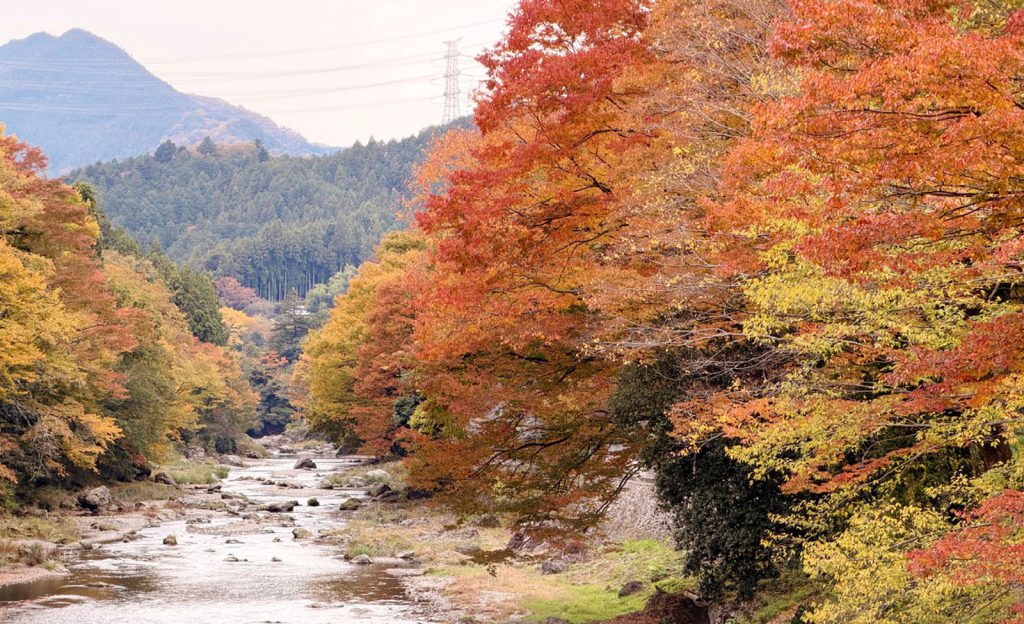
The valley stretches along the Akigawa River, offering beautiful views of forested hills, rocky riverbanks, and clear flowing water. Small bridges and walking routes provide opportunities to appreciate the scenery from different perspectives.
In October, the area is particularly pleasant for outdoor exploration. The weather is generally more comfortable than during midsummer, and the landscape retains much of its fresh green beauty.
Visitors can enjoy a leisurely riverside walk, explore local hiking routes, or stop at a countryside restaurant for a simple meal.
Akiruno is also known for local foods such as river fish, handmade konjac, and regional agricultural products. Trying local specialties can make the trip feel even more connected to the surrounding landscape.
For travelers who prefer a more relaxing afternoon, the wider Akigawa Valley area also offers hot spring facilities where visitors can unwind after exploring the countryside.
Whether you choose a short walk or a longer outdoor adventure, the combination of historic temples and natural scenery makes Akiruno an excellent destination for a day away from central Tokyo.
A Different Side of Tokyo
Tokyo is a city of extraordinary contrasts.
In the center, visitors can experience some of the world’s busiest streets, most advanced technology, and most exciting entertainment districts. Yet a journey west reveals another Tokyo—one of mountain villages, old temples, quiet rivers, and traditional landscapes.
Kotokuji Temple captures this contrast beautifully.
Its weathered thatched-roof gate, ancient trees, and peaceful courtyard seem to belong to another era. Meanwhile, the surrounding Akigawa Valley offers a refreshing reminder that Tokyo’s natural beauty extends far beyond its famous urban attractions.
For travelers visiting Japan in October, Akiruno offers the opportunity to enjoy the beginning of autumn without waiting for the peak foliage season. And for those who return in November, the temple’s golden ginkgo trees provide an entirely different experience.
Sometimes the most memorable journeys are not the ones filled with famous landmarks, but those that lead to places where time seems to move a little more slowly.
In Akiruno, that quieter side of Japan is waiting just beyond the city.
More Information
Kotokuji Temple (広徳寺)
234 Kowada, Akiruno City, Tokyo
Access
Take the JR Chuo Line and JR Itsukaichi Line to Musashi-Itsukaichi Station.
From the station, Kotokuji Temple is approximately a 30–40-minute walk, including some uphill sections.
Alternatively, take a bus toward Hossawa-no-Taki Iriguchi, Kazuma, Fujikura, or Kamiyozawa, get off at Kamicho, and walk approximately 15 minutes.
Admission
The temple grounds are generally free to visit.
As this is an active religious site, visitors should respect any restricted areas and posted notices.
Best Time to Visit
October: Pleasant walking weather, lush greenery, peaceful temple scenery, and the atmosphere of early autumn.
Mid-to-late November: The best period for the temple’s famous golden ginkgo trees and autumn foliage.
Travel Tips
Wear comfortable walking shoes, as the approach to the temple includes slopes and some narrow roads.
Allow half a day to explore Kotokuji and its immediate surroundings, or a full day if combining the visit with the wider Akigawa Valley.
For a quieter experience, weekday mornings are especially recommended.